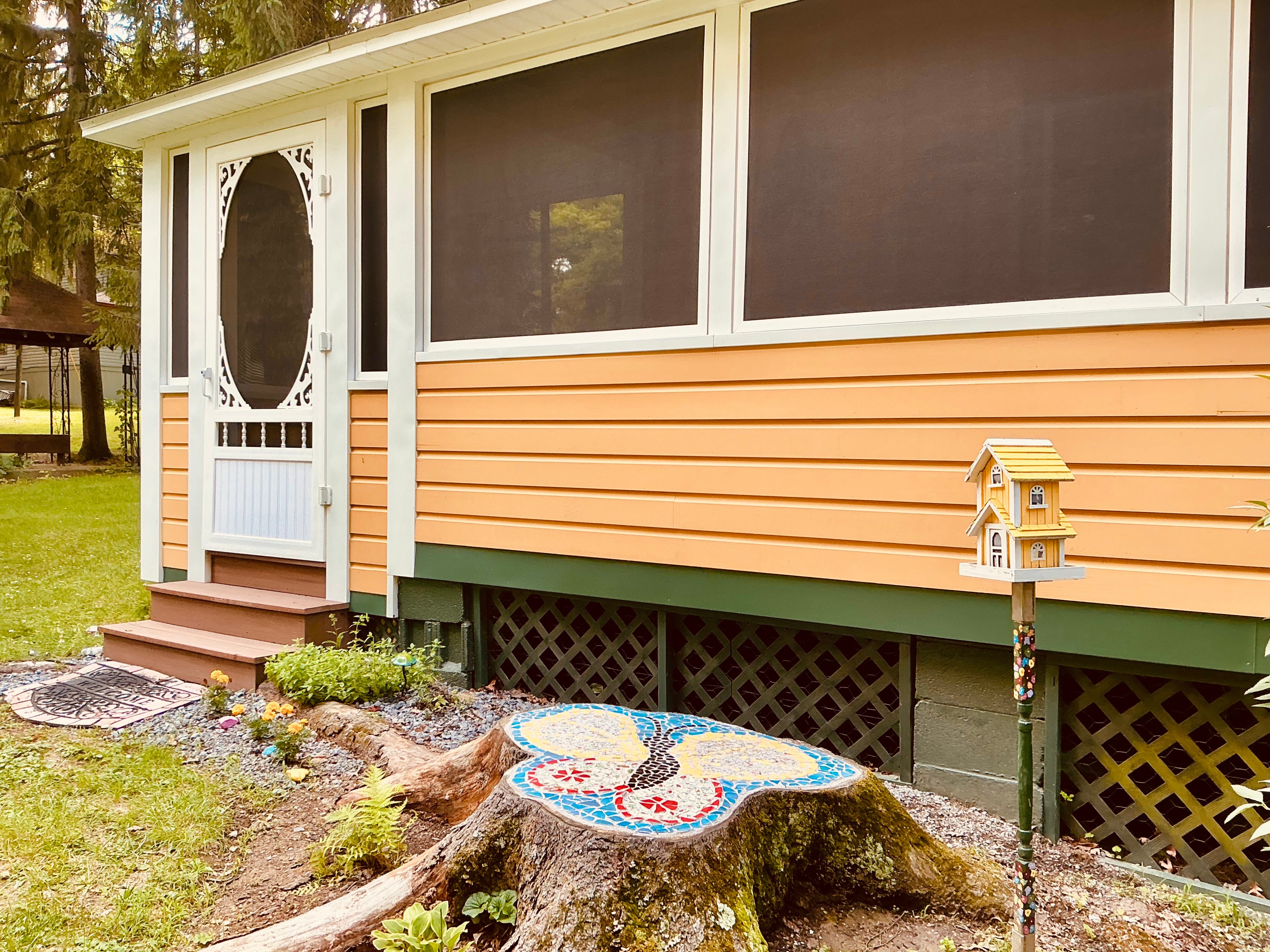
I am away with my wife and children this weekend at a family cottage located at Central Oak Heights. The dwelling was purchased after my in-laws settled the estate of the maternal grandparents and sought to invest in a place where heritage could be remembered and the expanding generations grow in relationship with family and friends. Situated on historical Pawnee territory, where inhabitation by the people of Shikellamy predated the birth of the United States, and purchased from the indigenous owners with an agreement that the virgin oaks of the grove could continue to grow uninterrupted, it is a beautiful place canopied with legacy and purpose.
Arriving at Central Oak Heights elicits a feeling that the time accrued there becomes “unpaused.” We experience the joy each trip of picking up where we left off. In sight of the tabernacle, and surrounded by artifacts of past generations of my wife’s family, there is a sacredness in this space that engages both a ritual and temporal feel. Like reading a beautiful poem, rich in the anticipation of its approaching end, and carried forward with fleeting recognition of form and rhythm, we engage in our seasonal recitation.
What are we to do with these very real differences in time perception? Are we merely deluded by biochemical responses evolved for survival? Time seems at once materially binding and idealistically arbitrary. We wear watches that count by the piezoelectric “tick” of quartz. We experience biological circadian rhythms and cellular decay bound to the chronicity of sunrises, sunsets, and the passing equinoxes. Yet quantum entanglement tells us that particles can communicate across distances without the need for light speed travel. The further one follows material cause to its foundational minutiae, the more blurred is the relationship of input and output. Ultimately, our only stable manner of understanding these dynamics is mathematical, not of direct observation, and math lives, substantively, in the realm of ideas.
To make this pragmatic, hold the idea of “noon” in your mind. This idea is probably a combination of clock-measurement, mealtime memories, and colloquialisms about the time of day. If I were to ask you, and indeed a crowd of people, to draw a picture of “noon,” I would receive pictures of clocks with the hour- and minute-hands at 12. Now ask yourself what represents best the concept “noon”: the idea in your mind, or the drawing of the clock.
Theistic idealism posits that all of reality is primarily ideas and thoughts, and our active experience is produced by the imagination of God. It is while on retreat, in worship, or engaged in creative acts, that this feels most resonant for me. While at the cottage, I feel a sense of God’s memory beyond my own, and a sense of nostalgia big enough to remember the dividing of land by sea. The writer Madeleine L’Engle has described this feeling of time saturated by the sacred as kairos, or as I like to think of it in more modern terms, focused presence instead of present-focus. This is the Greek word used when Jesus responds to the imprisonment of John the Baptist with announcing that “the time [kairos] has come” for the Kingdom of God to have its way [Mark 1:15.]
May you find time this Sabbath to experience the focused presence of the Divine.